Encapsulated Retinol Explained: Why Stability Matters
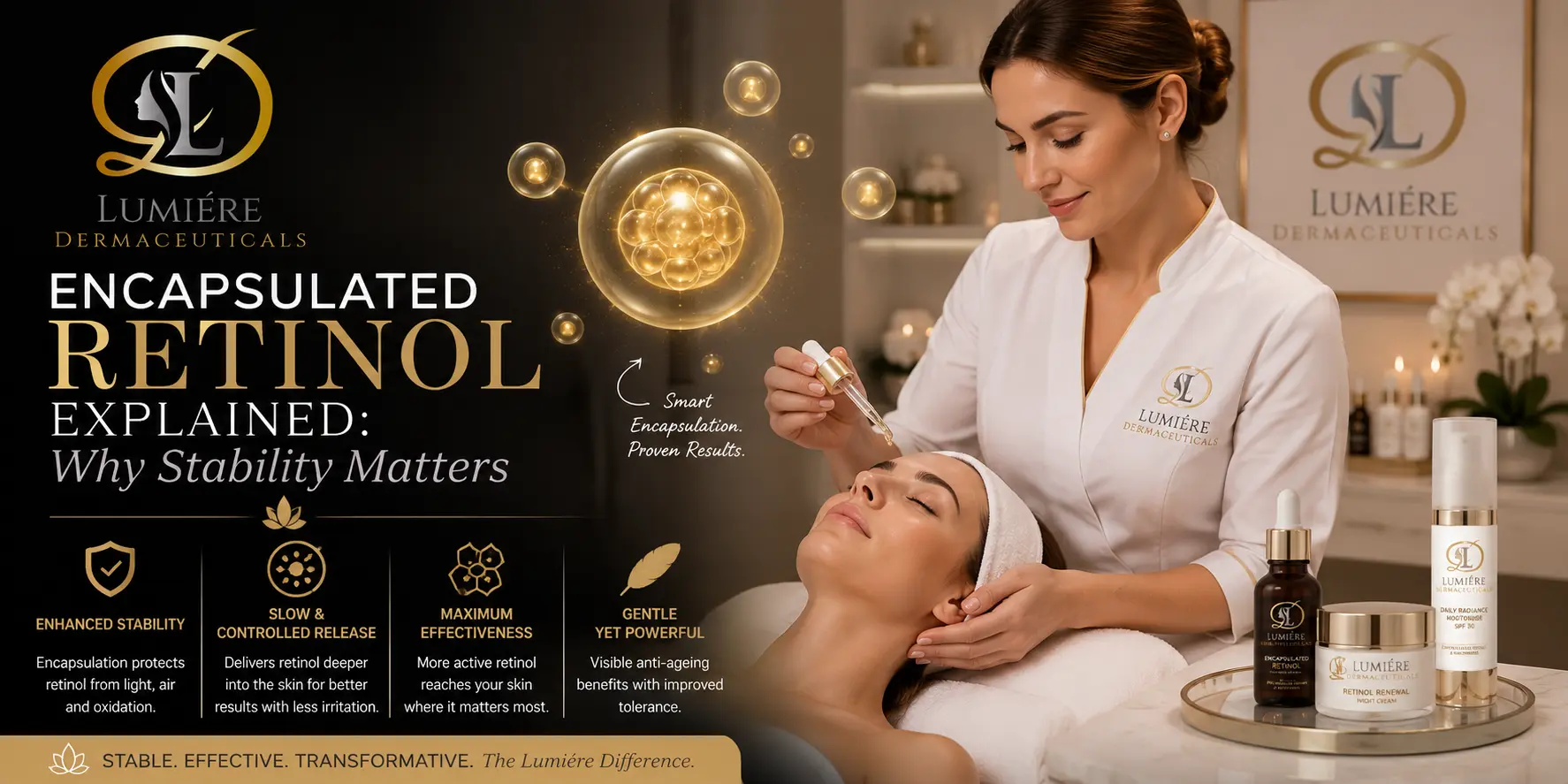
Retinol, as one of the most well-researched skincare ingredients, has an impeccable safety and efficacy profile. Studies demonstrate its ability to stimulate collagen production, improve texture, and enhance tone and pigmentation. The only challenge with retinol is its instability outside of ideal conditions. A product containing retinol will begin to break down as soon as it is exposed to light, air, or heat, resulting in an ingredient that is less potent than what was originally put into the formula. This is why encapsulation was invented.
What Encapsulated Retinol Actually Means
The term “encapsulated retinol” refers to retinoids enclosed in a special microcapsules, which are broken upon rubbing the substance into the skin, thereby releasing their contents. Encapsulation technology allows for the development of cosmetics products that contain active retinol, while being less irritating to the skin and remaining potent for a long time after opening.
The main advantage of encapsulated retinol is connected to its ability to stay active for a long time after the product is opened. This means consumer will benefit from using such cosmetics longer than they would with regular retinol preparation. The second advantage is the reduced side effects of using retinol, caused by its slower release into the skin. Both advantages are explained by the fact that encapsulated retinol is subject to a slower release mechanism due to the need to break the capsules in order to access the contents.
Why Controlled Release Changes the Experience
Anyone who has used Retinol and experienced irritation, flakes, and a tight sensation after the first weeks of use will understand why tolerance is essential. And this is primarily due to the fact that non-encapsulated Retinol is very potent. The reason for this is because it begins to work almost immediately after applying to the skin:
• Encapsulation allows the skin to tolerate the retinol and reduces irritation due to its slow release from special microcapsules – this way Retinol acts gradually on skin cells
• Therefore, encapsulated retinol products are especially good for sensitive skin or people new to Retinol treatments
• Meanwhile, the ingredient’s potency remains intact for much longer, as very little is lost during the manufacturing process
On the whole, encapsulation allows Retinol to maintain its potency while being kinder to the skin – it is no less effective than standard Retinol but has a longer shelf life and is more tolerant for most skin types.
Why Evening Use Matters
Retinol is broken down by UV exposure, which is one of the main reasons it’s formulated for night-time use. Applying it in the morning under direct sunlight significantly reduces its effectiveness and increases the likelihood of irritation, since retinol also increases the skin’s sensitivity to sun.
- Apply in the evening, after cleansing and before your moisturiser
- Always follow with a broad-spectrum SPF the next morning, since retinol use increases photosensitivity even though it’s applied at night
- If you’re new to retinol, start with two to three nights a week and build up gradually as your skin adjusts, rather than starting with nightly use
- Avoid layering with other strong actives such as exfoliating acids on the same night, at least until your skin has built tolerance
A Note on Pregnancy and Breastfeeding
Important: Retinol and other vitamin A derivatives are generally not recommended during pregnancy or while breastfeeding. If you are pregnant, trying to conceive, or breastfeeding, speak with your doctor or a qualified skin professional before using any retinol product, and consider a pregnancy-safe alternative in the meantime.
This caution extends beyond just encapsulated products. Whether it’s encapsulated or not, it’s about the active ingredient, not the delivery system, so if you’re unsure, always check with your GP, Obstetrician or skin therapist – don’t rely on what’s on the packaging.
Choosing the Right Encapsulated Retinol for Your Skin
Not all encapsulated retinol products are created equal, and the amount of the ingredient, other active ingredients, and your skin’s sensitivity, will affect how it will work for you. Some people with healthy skin can tolerate a higher concentration more often, whereas those with sensitive skin may need to start with a lower concentration and allow their skin to adjust.
If you are on the fence about where to start, it is always a good idea to get professional advice. Retinol is one of those products where the right concentration and frequency will make all the difference in how well it works for you and how harsh it might be to your skin.
Explore Our Encapsulated Retinol Range
Browse our range of encapsulated retinol serums, formulated for stability and gradual tolerance. New to retinol? Our starter routine is designed to introduce retinol gently alongside the right supporting products.
Not sure which strength or routine suits your skin? Book a consultation with our team at Lumiére Dermaceuticals. Clinics and professionals interested in stocking our range can find details on our wholesale enquiry page, and our training page covers correct retinol protocols for professional use.
Already using retinol? Pair it with our aftercare and barrier support range to help manage sensitivity while your skin builds tolerance.
Frequently Asked Questions
Is encapsulated retinol better than regular retinol?
It is not necessarily stronger, but works better in terms of stability and is generally better tolerated, which for many is ultimately an issue when using retinol creams – hence the practical benefits of using it on a regular basis. And this is one of these cases when regular use is indeed crucial in order to achieve results.
Can I use encapsulated retinol every night?
Some people can, but it depends on how much your skin can tolerate and the percentage of the product. It is best to start with two or three nights a week and slowly work your way up.
Do I still need sunscreen if I only use retinol at night?
Yes. Retinol increases your skin’s sensitivity to UV even though it’s applied in the evening, so daily broad-spectrum SPF is essential while using any retinol product.
Is encapsulated retinol safe to use with vitamin C?
Yes, Retinol does increase your skin’s sensitivity to sunlight, even if you apply it at night, so it’s critical to use a daily broad spectrum SPF when using any form of Retinol.
How long does it take to see results from encapsulated retinol?
Many people use vitamin C in the morning and Retinol at night with no issues, thus avoiding any possible interactions. If you want to use both, you could start by introducing one and waiting a few days before adding the other.
Can I use retinol if I’m pregnant or breastfeeding?
Retinol or other vitamin A derivatives are typically contraindicated during pregnancy and breastfeeding. Please consult your physician or skin specialist about your individual case and possible alternatives.